
Somewhere in a big company right now, a lawyer is scrolling a 200‑page regulation in a PDF that was clearly not designed for human eyes, while a board slide calmly says “we’re de‑risking with AI.”
Legal and compliance work is the perfect storm: rules keep changing, documents keep multiplying, and everyone wants answers faster with less budget. Great combo.
So of course, the pitch now is “AI legal assistant.” Tools like Harvey, CoCounsel, Lexis+ AI, Spellbook, Genie, and a dozen others promise everything from 50–80% faster contract review to “litigation intelligence” that finds claims before your regulators do. Law firms and Big 4 giants are not just talking about this on panels; they’ve rolled it out to thousands of lawyers already.
The point of this article is simple: if you’re AI‑curious and law‑adjacent (student, engineer, product, junior in a legal ops team), you should know which tools are actually shaping workflows and where the line is between “assist” and “absolutely do not let this thing give final legal advice.”
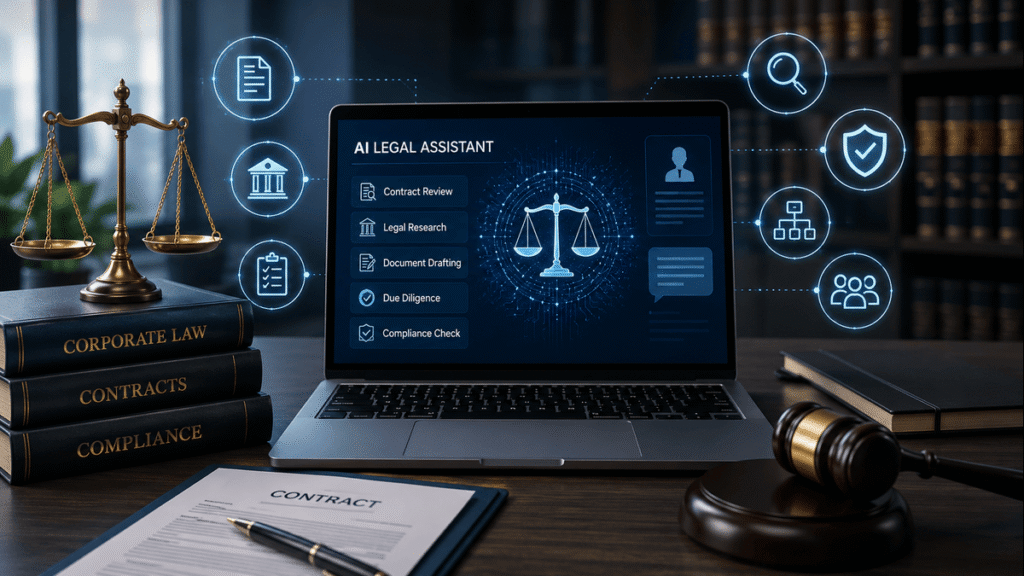
THE THING NOBODY ACTUALLY SAYS OUT LOUD
Every glossy “AI for legal” announcement has the same line: “AI will not replace lawyers.” PwC literally wrote that into their press release when they announced their exclusive global partnership with Harvey. It’s not just PR; their regulators would have questions if they said anything else.
The truth everyone feels but doesn’t spell out:
AI is coming for junior‑lawyer‑style work, not the signature line at the end of the memo.
When Allen & Overy rolled out Harvey to 3,500+ lawyers across 43 offices, they weren’t using it to sign opinions. They used it to:
- draft and redraft clauses
- summarize long documents
- answer “what’s the rule in X jurisdiction on Y topic?”
- help with research queries that used to eat half a day
Same with PwC’s 4,000‑lawyer deployment: contract analysis, regulatory compliance checks, and due diligence support not “Harvey, please advise on this bet‑the‑company litigation.”
There’s a reason:
- AI tools like Harvey and Genie can cut contract review time by 50–80%, lower errors by around 40%, and boost first‑draft productivity by roughly 5x in some workflows.
- AI‑powered legal research like Thomson Reuters’ CoCounsel and Lexis+ AI can take research that used to be “hours in Westlaw” down to minutes, with direct links to cases and practical guidance.
But nobody in their right mind signs off on legal advice that came only from a model, no matter how fancy the “Legal‑Grade™ AI” branding is.
The thing people don’t say openly in marketing copy:
- Legal AI tools are at their best when they’re glorified force multipliers for humans.
- They are at their worst when someone treats them like “ChatGPT, but for law, so I don’t need to think.”
Another quiet truth: compliance teams care as much about proving what they checked as they do about checking it. That’s why serious platforms log queries, show document trails, and often confine themselves to suggesting, flagging, and summarizing. If you can’t show a regulator “here’s how we monitored this obligation,” you’re back to vibes.
From an AI/tech student standpoint, the interesting bit isn’t “oooh law AI.” It’s this: some of the ugliest, most business‑critical problems in legal contract obligations, discovery, regulatory mapping are now being tackled with very real ML, LLMs, anomaly detection, and retrieval‑augmented search at scale. The job isn’t to “replace lawyers.” It’s to stop them from spending entire days as human OCR.
HOW THIS ACTUALLY WORKS THE REAL MECHANICS
Under the hood, top AI tools for legal and compliance are less magic and more plumbing: structured data, retrieval, and models glued into boring workflows.
You can split most of them into four big buckets.
1. Legal AI assistants & research platforms
Think Harvey, CoCounsel, Lexis+ AI, GC‑style assistants.
Mechanics:
- Ingest huge proprietary databases: Westlaw, Lexis case law, statutes, regs, treatises, internal knowledge bases.
- Use LLMs for natural‑language queries: “Summarize GDPR requirements for data processing agreements for B2B SaaS vendors.”
- Retrieve relevant primary sources and guidance, then draft summaries, arguments, or checklists with citations.
Why it matters:
- TR’s CoCounsel touts itself as a “single AI tool” that does research, drafting, and document analysis across Westlaw, Practical Law, M365, and DMS tools in one interface.
- Lexis+ AI emphasizes “verified legal citations” tied directly to LexisNexis content, trying to de-risk hallucinations.
Opinion: These are less like ChatGPT and more like steroids for your traditional research platforms and they live or die on the quality of their underlying content.
2. Contract lifecycle & review tools
This is where AI quietly saves the most money. Tools include SpotDraft, Sirion, Luminance, Spellbook, LawGeex, Genie, and others.
Mechanics:
- Use NLP/LLMs to parse contracts, identify clauses, compare to playbooks, and score risk.
- Flag missing clauses, non‑standard terms, and deviations from your “market standard” or company fallback positions.
- In CLM platforms like Sirion, AI is embedded from drafting → negotiation → execution → obligation tracking.
Legal teams using these tools report:
- faster deal cycles
- better visibility into obligations and renewals
- Stronger negotiation positions because AI can show live “what’s market” comparisons across thousands of contracts
Opinion: this is less “write me a contract” and more “don’t let that weird indemnity clause slip through at 11 pm”
3. Litigation, eDiscovery & “legal intelligence”
Platforms like Everlaw, Darrow, Lex Machina, and others sit here.
Mechanics:
- E‑discovery: use ML to classify and prioritize millions of documents, emails, chats, and files for relevance and privilege.
- Litigation analytics: analyze case histories, judge behavior, party patterns, outcomes, and settlement values.
- Anomaly detection: Darrow-type tools scan public records and data for patterns that indicate legal violations, then surface them as potential claims or risks.
For compliance, that last part is huge: you’re not just reacting to issues; AI is watching for patterns that look like issues before regulators do.
4. Compliance monitoring & legal ops platforms
This is where legal meets “ops brain”: GC‑style platforms, Lawxy AI, Sirion compliance analytics, and legal ops suites.
Mechanics:
- Track obligations from contracts and regulations: SLAs, audit rights, data‑processing terms, reporting deadlines.
- Monitor adherence in near real-time, flag breaches and upcoming obligations, and produce audit-ready reports.lawxyai+1
- Integrate with ERP, CRM, procurement, and ticketing tools to avoid data silos.
Sirion’s breakdown is clean: CLM with embedded AI runs authoring, negotiation, signatures, and performance monitoring; dedicated review tools plug into M&A due‑diligence and vendor onboarding; compliance analytics watch obligations and service levels.
The niche angle: top‑tier GCs now talk about AI not just as tooling but as part of “legal operating systems” Filevine on the practice side, GC AI‑style suites on the corporate side. That’s code for “we’re embedding AI into every legal workflow, not just buying one research bot.”
COMPARISON WHAT’S ACTUALLY DIFFERENT BETWEEN YOUR OPTIONS
Here’s a simplified comparison of some flagship tools and categories.legalfly+9
| Option / Category | What it actually does | Who it’s for | The catch |
| Harvey (AI legal assistant) | LLM‑based assistant for drafting, reviewing, and research; Deployed at Allen & Overy and PwC to speed contract work and compliance tasks. | Large firms and enterprise legal teams with serious volume and budgets. | Mostly enterprise‑only; requires strong governance and data controls. |
| CoCounsel Legal / Lexis+ AI | AI assistants embedded in Westlaw / Lexis ecosystems for research, drafting, and document analysis with trusted citations. | Lawyers and legal departments already living in TR or Lexis stacks. | Locked into vendor content; Subscriptions aren’t cheap. |
| Contract AI / CLM (Sirion, SpotDraft, Luminance, Spellbook, Genie) | AI across contract authoring, review, negotiation, and obligation tracking; Identifies risk, missing clauses, and compliance gaps. | In-house teams drowning in contracts and vendor/customer negotiations. | Needs clean playbooks and templates; garbage in, garbage out. |
If you want a blunt POV:
- If your bottleneck is research and drafting , start with CoCounsel or Lexis+ AI depending on your content vendor.
- If your bottleneck is contracts , get serious about a CLM with real AI baked in (Sirion, SpotDraft, Luminance, Spellbook, Genie) instead of ten random Word templates.
- If you’re a giant org or top-tier firm, Harvey-class assistants make sense but only if you also build the process and governance muscle around them.
WHAT ACTUALLY HAPPENS WHEN YOU TRY THIS
When a legal or compliance team actually rolls out AI, it doesn’t look like “we turned on Skynet.” It looks like killing piles of work that nobody will miss.
You start with contracts because contracts are where time goes to die. You plug in an AI review tool tied to your playbook. Instead of junior lawyers reading 60 NDAs line‑by‑line, the tool:
- flags non‑standard terms (weird governing law, unilateral termination rights, sketchy IP clauses)
- highlights missing boilerplate your org cares about
- gives a “risk profile” per document so humans can focus on the 10 ugly ones, not the 50 boring
What surprised me the first time I saw this in action was how fast lawyers stopped arguing about whether AI should be involved at all and started arguing about playbook logic instead. Once the tool reliably spots 80% of the obvious issues, the real work becomes “okay, what actually counts as acceptable risk for us?”
Next, research. A senior asks, “What’s our exposure under X regulation if we roll this product out in Y region?” Pre‑AI, someone disappears into Westlaw/Lexis for a day. With CoCounsel or Lexis+ AI, they ask a conversational query, get a structured answer with cited authority, and then… still read the cases. The model gives a map; Humans still decide where to walk.legal.
On the compliance side, you wire a CLM or compliance analytics tool into your ERP/CRM:
- Obligations from data‑processing agreements, SLAs, and audit clauses get extracted and put into a tracking system
- Missed reporting deadlines or SLA breaches trigger alerts, not “surprise” letters
- you finally have a dashboard instead of a spreadsheet someone secretly
The pattern most listicles miss: the first real “AI win” often shows up as a boring metric like “cycle time on routine contracts dropped by 30–50%” or “we caught three SLA breaches before customers yelled,” not “AI argued a case in court.”
One thing that genuinely surprises teams: how quickly lawyers start trusting tools when they’re paired with clear guardrails. PwC’s Harvey rollout came with an explicit promise AI would not replace lawyers or provide advice by itself. That framing matters. People are much more willing to use a system if it is defined as “assistant” from day one, not “potential replacement.”
What nobody talks about enough: you also see workflows that don’t work well with current AI. Anything involving nuanced judgment on novel issues, sensitive internal politics, or cutting‑edge regulatory interpretation still needs a human brain end‑to‑end. The AI can summarize facts and draft options, but it cannot tell your board whether to pick war or settlement.
When it’s done right, “AI in legal” doesn’t feel like tech theater. It feels like fewer nights redlining page 37 of the vendor’s MSA for the fifth time and more time arguing about strategy, which is what you were billed for in the first place.
THE ADVICE EVERYONE GIVES VS WHAT ACTUALLY WORKS
“Start with a generic AI assistant and let lawyers experiment”
This sounds agile and fun. It also usually ends in chaos: random queries, no governance, and someone accidentally pasting confidential data into a tool with sketchy terms.
Why it fails:
- No alignment on use cases or risk appetite.
- No integration with your actual systems (DMS, CLM, research tools), so usage remains toy‑level.
What actually works: pick 1–2 high‑value workflows eg, NDA review, basic research memos and roll out AI inside tools you already trust (Westlaw, Lexis, your CLM). Add guidelines: what’s allowed, what isn’t, and how outputs must be checked.
“AI will make junior lawyers obsolete”
It will absolutely eat the worst parts of junior work: endless doc review, first-pass contract markup, brute-force research. But someone still has to understand the output, push back against counterparties, and explain risk to non-lawyers.
Why this take is lazy:
- It ignores how much glue work juniors do between teams.
- It assumes AI output is plug-and-play, which every GC who’s ever edited an AI draft knows is false.
What actually works: treat AI like a multiplier for juniors: train them on how to prompt, verify, and correct AI, and let them handle more complex work earlier because they’re not buried under grunt tasks. The teams that do this well get both cost savings and a stronger pipeline of mid‑levels.
“You need one ‘platform to rule them all’”
Vendors love the “all-in-one” narrative. Reality is more messy: research, contracts, eDiscovery, and compliance live in different ecosystems for good reasons.
Why this backfires:
- You end up locked into a monolith that does four things at 60% instead of two things at 95%.
- Legal teams resent being forced into tools that don’t match their domain workflows.
What actually works: pick best‑in‑class tools per domain and make sure they integrate with your identity, DMS, and core business systems. A CLM with good APIs plus CoCounsel/Lexis+ AI plus a compliance platform is often healthier than one giant “solution” you can’t escape.
“Just trust the AI, it’s trained on legal data”
Legal-grade training sets and verified citations help, but they don’t remove hallucination risk or context gaps. Models can still misinterpret edge cases, outdated law, or jurisdictional quirks.
Why this is dangerous:
- Over-trust leads to unreviewed drafts making it to clients or regulators.
- It erodes credibility the first time the AI is obviously wrong and nobody catches it.
What actually works: use AI to propose answers, summaries, and drafts with clear source links, then require human review for anything leaving the building. Think of it like a paralegal that’s incredibly fast but occasionally overconfident.legal.
THE PRACTICAL PART WHAT TO ACTUALLY DO
Assume you’re either a tech-minded person near legal/compliance, or someone who might build for this space. Here’s how to approach it like an adult.
1. Map where legal and compliance actually lose time
Talk to real lawyers/compliance folks. Listen for:
- “We spend days on contract review / NDAs / DPAs.”
- “Regulatory tracking is a nightmare, we live in spreadsheets.”
- “Our research is all over the place; we redo work because nobody can find old memos.”
That’s your AI opportunity set. Tools like Sirion suggest starting with the highest‑friction workflow: contract authoring, obligation tracking, or compliance monitoring, not “AI everywhere.”
2. Pick a domain, then match it to a tool category
Rough guide:
- Contracts hell → CLM + contract AI (Sirion, SpotDraft, Luminance, Spellbook, Genie).
- Research overload → CoCounsel or Lexis+ AI depending on vendor stack.
- Litigation and investigations → eDiscovery + litigation analytics + anomaly detectors like Darrow.
- Ongoing compliance → AI‑backed compliance/GC platforms (Lawxy AI, Sirion analytics, GC‑type tools).
Don’t start by saying “we want Harvey because it sounds cool.” Start with “we want to cut NDA review time in half” and then ask which tool realistically does that.
3. Design the workflow before buying anything
For your chosen use case, write down:
- inputs (eg, third‑party paper, your templates, regulatory feeds)
- steps (review, compare to playbook, mark‑up, approvals, sign)
- outputs (approved contract, risk register entry, audit log)
Then decide where AI sits: clause extraction, deviation flagging, first‑draft redlines, research summaries, obligation tracking. This alone will filter out tools that don’t fit your reality.
4. Run a pilot with tight scope and metrics
Pilot one team or one process:
- eg, “All NDAs in Q3 go through CLM + AI review” or “All marketing‑law queries go through CoCounsel first.”
Track: - time per item before vs after
- error/exception rate
- user satisfaction (“do you trust the suggestions?”)
If the tool doesn’t move those numbers meaningfully, it’s either misconfigured or not worth it.
5. Set clear guardrails and training
Document:
- what types of matters AI can touch (routine contracts, internal memos, low‑risk queries)
- what it cannot touch (novel issues, high‑stakes litigation strategy, privileged communications without controls)
- how outputs must be reviewed and stored
Use examples from Harvey/PwC/Allen & Overy: they explicitly say AI does not replace legal advice. Copy that energy.
6. Focus on integration and data hygiene early
Ask every vendor:
- how do you connect to our DMS, CLM, CRM, ERP, ticketing?
- Where is data stored and how is it segregated?
- Can we control which jurisdictions/content sources the AI uses?
Sirion and similar CLMs argue that standalone tools just create more silos; the good ones wire into the rest of your stack. Without integration, even the smartest AI ends up as another place knowledge goes to die.
7. Iterate and expand only when the first use case is boringly stable
Once NDA review or basic research is clearly better with AI, you can:
- add more contract types
- expand research coverage
- plug in compliance monitoring and analytics
But make sure the first workflow feels normal to users not like a science experiment before you fan out. Adoption in legal is trust-driven; one bad rollout can kill appetite for three years.
QUESTIONS PEOPLE ACTUALLY ASK
What are the best AI tools for legal and compliance teams in 2026?
For research and drafting, CoCounsel (Thomson Reuters) and Lexis+ AI are leading options, built on top of Westlaw and Lexis content respectively. For contracts and CLM, platforms like Sirion, SpotDraft, Luminance, Spellbook, and Genie AI embed AI across drafting, review, negotiation, and compliance tracking. At the big‑firm/enterprise end, Harvey is being used by players like Allen & Overy and PwC to supercharge internal legal work.
How are firms like PwC and Allen & Overy actually using Harvey?
They use Harvey as an internal assistant for contract analysis, regulatory compliance, due diligence, document drafting, and research support. PwC gave 4,000 legal professionals access, while Allen & Overy rolled it out to more than 3,500 lawyers globally. Both stress that Harvey supports lawyers and does not replace human legal advice, which is key for client trust and regulatory reasons.
Can AI tools replace human lawyers or compliance officers?
No. Vendors and adopters are explicit that AI assists, not replaces. Tools can cut contract review times by 50–80%, reduce errors, and handle first‑draft research and analysis in minutes instead of hours. But humans still interpret novel issues, weigh business risk, negotiate, and sign off on decisions. Treating AI as a replacement rather than an assistant is both risky and, in most regulated contexts, unacceptable.
What’s the difference between CoCounsel and Lexis+ AI?
CoCounsel Legal sits inside the Thomson Reuters ecosystem and focuses on AI‑powered research, drafting, and document analysis across Westlaw, Practical Law, and Microsoft 365 in one interface. Lexis+ AI is LexisNexis’s generative research platform with an emphasis on verified citations tied directly into the Lexis case law database and its evolving Protégé assistant. Choice usually comes down to which content vendor your org already uses and trusts.
How do AI contract tools help with compliance?
AI‑enabled CLM platforms like Sirion, Luminance, and SpotDraft extract obligations from contracts (SLAs, audit rights, data‑processing terms) and track them over time. They can flag missing risk clauses during review and later monitor performance and breaches, giving legal and compliance teams real-time visibility instead of relying on scattered spreadsheets. That directly improves compliance posture and reduces the chance of “we didn’t know we were out of contract.”
Are these tools safe from a data and confidentiality perspective?
Serious legal AI vendors emphasize security, data segregation, and alignment with professional obligations, often supporting on-prem or private cloud setups. PwC’s and Allen & Overy’s partnerships with Harvey, for example, came with strong statements that client data remains protected and AI is used under lawyer supervision. That said, any deployment should go through info-sec, with clear policies about what data can be fed into which tools.
Where should a legal or compliance team start with AI?
Most experts suggest starting where time and risk are highest: contract review, standard NDAs, repetitive research questions, or basic compliance monitoring. Pick one workflow, integrate AI into tools you already use (CLM, Westlaw/Lexis, matter management), and measure cycle time, error rates, and user experience before scaling. A small, well-run pilot beats a flashy, firm-wide “AI rollout” that nobody actually uses.
SO WHERE DOES THIS LEAVE YOU?
Legal and compliance teams have quietly become some of the heaviest real-world users of AI not because they’re tech-obsessed, but because the work is repetitive, high-stakes, and increasingly impossible to do manually at scale.
You now live in a world where an AI assistant can draft your first markup of a DPA, summarize a 200‑page regulation for a specific use case, and tell you which contracts hide the riskiest terms long before a dispute hits. None of that removes the need for judgment. It just removes the need to suffer through the most mechanical parts of the job.
If you do one concrete thing after reading this, pick one legal workflow NDAs, policy research, vendor onboarding, or SLA tracking and sketch how an AI‑enabled tool might cut the manual steps in half. Then cross-reference that with tools like CoCounsel, Lexis+ AI, or CLMs like Sirion/SpotDraft/Luminance to see who actually serves that slice. “AI in legal” stops being buzzwordy very fast when you’re looking at one specific bottleneck instead of The Law as a whole.legal.
You read a full article about AI tools for legal and compliance without enrolling in law school or doom‑scrolling to the next meme, which is a good sign.
These tools won’t turn you into Harvey Specter or make regulatory risk disappear in a puff of machine learning. They will, if you point them at the right places, quietly slice hours out of contract review, research, and monitoring the boring grind that used to be the price of admission. The rest is still on humans: deciding what risks to take, what to ship, and when to say “no” even if the model says “looks fine.”