
You know that moment when your phone “magically” fixes a terrible photo, live‑translates a call, and summarizes your notes while you’re on airplane mode? That’s not the cloud being generous. That’s edge AI quietly doing leg day.
Smartphones and IoT gear have gone from “dumb pipes that send data to servers” to “tiny computers that run real models locally.” On‑device AI is now an actual industry term, not just marketing fluff: mobile NPUs and edge chips are doing inference right on phones, wearables, cameras, and gateways, without shipping every byte to some GPU farm. The money is following that shift global edge AI hardware is projected to grow from around 6.65 billion USD in 2026 to over 22.6 billion by 2034, while broader edge AI platforms are forecast to hit about 245 billion by 2040.
If you’re an AI/tech student, this is the interesting part: edge AI is changing what you can build, where you can run it, and what the UX feels like when you don’t have to ask a distant server for permission every time the user taps a button.
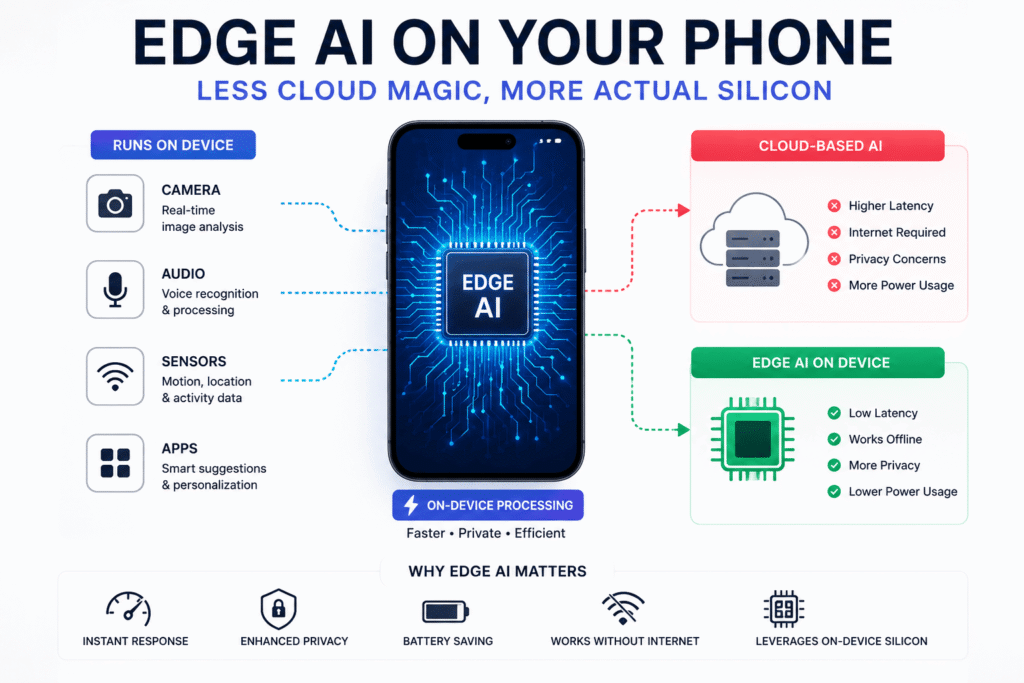
THE THING NOBODY ACTUALLY SAYS OUT LOUD
Most blog posts talk about “edge AI” like it’s a buzzword upgrade to “IoT.” In pitch decks it sounds like: smart cities, autonomous drones, Industry 4.0, dramatic stock photos of factories.
The unsanitized version is more like:
We tried sending everything to the cloud. The bill, latency, and privacy issues said “no.” So now we are shoving as much intelligence as possible into the devices themselves.
A few awkward truths that don’t make it into keynote slides:
- There is way too much data. IDC estimated over 41.6 billion IoT devices by 2025, generating insane streams of sensor data. If you try streaming all of that to the cloud, you pay in bandwidth, latency, and angry network teams. Edge computing and specifically edge AI is the only way to keep up.
- Latency is not a “nice to have” in many use cases. If your camera is doing real‑time person detection, or your phone is live‑translating a call, 300 ms vs 30 ms is the difference between “wow” and “I guess it’s broken.” Edge AI runs inference right next to the data so you don’t wait on a round‑trip to Virginia.
- Privacy isn’t just a moral stance; it’s a product constraint. On‑device AI means photos, biometric data, health metrics, and raw audio often never leave the device which is a big deal for GDPR/CCPA/health data and for people who don’t want every selfie in a training set.
Look at current flagship phones. Snapdragon 8 Gen 3, Samsung Exynos AI chips, Apple’s neural engines, MediaTek NPUs all are explicitly marketed as “on‑device AI accelerators.” Samsung’s Galaxy S24, Xiaomi 14, Oppo Find X7, and others ship features like:semiconductor.
- on‑device live call translation and transcription,
- AI photo erasers and portrait generators running locally,
- keyboard and note apps with on‑device LLMs for rewriting and summarization.
None of that exists without edge AI. You’re literally carrying a model host around in your pocket.
And out in the world, edge AI chips like Google’s Edge TPU, NVIDIA Jetson modules, and ultra‑low‑power NPUs are hiding inside cameras, industrial sensors, and gateways doing object detection, anomaly detection, predictive maintenance, or local control under tight power budgets.
The uncomfortable bit for cloud-only people: a lot of the coolest stuff in AI over the next decade is going to happen in places where you don’t see a GPU rack at all. Just a phone, a wearable, or a weird little box bolted to a wall.
HOW THIS ACTUALLY WORKS THE REAL MECHANICS
Strip away the hype, and “edge AI on phones and IoT” mostly comes down to three pieces: hardware, model optimization, and smart partitioning between device and cloud.
1. Hardware: NPUs and edge AI chips
Smartphones now ship with dedicated Neural Processing Units (NPUs) sitting alongside CPUs and GPUs.
- CPUs are the Swiss army knife flexible but not specialized.
- GPUs are great for parallel math, originally built for graphics.
- NPUs are built specifically for neural network operations like matrix multiplies and convolutions, with many operations running in parallel at low power.
Qualcomm’s Snapdragon 8 Gen 3, for example, integrates an NPU tuned for generative AI and local LLMs, powering features like camera AI, voice enhancements, and keyboard assistants. MediaTek’s edge AI architecture does something similar across phones, tablets, smart TVs, and AIoT devices.
In IoT, you see:
- low‑power accelerators like Google’s Edge TPU for battery‑powered sensors and cameras,
- higher‑TOPS modules like NVIDIA Jetson Orin AGX (up to ~275 TOPS at 10–60 W) and SiMa.ai / Axelera chips for gateway or device‑level inference with serious performance.
The edge AI chip market is projected to jump from about 21.2 billion USD in 2025 to 217.2 billion by 2035 a 26%+ CAGR because every vertical (auto, phones, industrial) wants local intelligence now.
2. Model optimization for the edge
You can’t just drop a 30B‑parameter model on a smartwatch. Edge AI is a lot of: “How do we squeeze useful behavior into models that fit in a few MB and run under strict power constraints?”
Common tricks:
- Quantization : reduce weights/activations from 32‑bit float to 8‑bit or lower. Huge gains in speed and memory, minor hit in accuracy when done well.
- Pruning : chop off less‑important weights and neurons, making the model sparse and lighter.
- Knowledge distillation : train a small “student” model to mimic a large “teacher” model. You keep most of the behavior with less compute.
A 2025 survey of edge AI for low-power IoT devices calls these the core techniques to hit real-time constraints under harsh energy budgets. Toolchains like TensorFlow Lite, Core ML, and ONNX Runtime Mobile bake these into their conversion flows for mobile and embedded apps.
3. Hybrid architectures: device + cloud
The punchline from mobile dev guides is: edge AI vs cloud AI is not “either/or” it’s “who does what.”
On‑device AI (edge) runs models locally on the phone or sensor.semiconductor.
- Pros: low latency, offline capability, better privacy, less bandwidth.
- Cons: constrained compute, battery, smaller models.
Cloud AI runs on remote servers.
- Pros: big models, heavy training and analytics.
- Cons: latency, connectivity requirements, data residency headaches.
Most real systems in 2026 use a hybrid pattern:
- quick, privacy‑sensitive tasks (face unlock, camera enhancement, wake words, gesture detection) on device,
- heavier tasks (large‑context LLM queries, complex analytics) in the cloud when connectivity is okay.
COMPARISON WHAT’S ACTUALLY DIFFERENT BETWEEN YOUR OPTIONS
From a builder’s point of view, “edge AI on phones and IoT” is really a choice between where you put the brain and how much power you burn.
| Option / Pattern | What it actually does | Who it’s for | The catch |
| Pure cloud AI | All inference happens in the cloud; Devices just send data and show results. | Apps need big models & don’t mind latency (analytics, batch). | Needs constant network, higher bandwidth, worse privacy. |
| Pure edge AI (on-device only) | All inference happens locally on phone/IoT hardware; no cloud dependency. | Real-time, privacy-sensitive, or offline‑critical use cases. | Model size, updates, and hardware limits can hurt flexibility. |
| Hybrid edge + cloud | Split: quick, private work on device; heavy or global tasks in the cloud. | Most serious apps in 2026 (smartphones, industrial IoT). | More complex architecture; you must design where the boundary lives. |
If you’re working on mobile apps, you generally want hybrid: push anything latency‑sensitive or privacy‑sensitive on‑device, and keep “large context + heavy lifting” in the cloud. For IoT, low-power sensors might only do simple analytics locally and send condensed events upstream, while gateways or edge servers run bigger models.
WHAT ACTUALLY HAPPENS WHEN YOU TRY THIS
When you actually ship an app or device with edge AI, it feels less like sci-fi and more like debugging a very opinionated roommate.
On phones, the difference shows up the first time you use an “AI” feature in airplane mode. Samsung’s Galaxy AI lets the S24 series do live translation of calls, AI photo editing (eraser, portrait tweaks), and even on‑device text rewriting and tone changes directly in the keyboard, thanks to NPUs and local LLMs. Xiaomi is doing on‑device AI portraits that generate new selfies in different environments based on a few shots of your face, all without sending those photos to a server. Oppo’s AIGC Eraser runs entirely offline once you download the pack, removing objects from photos locally.
Using this stuff in real life, you notice:
- it feels instant compared to “upload → spinny loader → result,”
- battery hit is noticeable but way better than keeping a network radio cranked all day,
- you don’t get that “should I really upload this?” hesitation as much, because you know processing stays on device.
When you build for it, you start fighting different dragons:
- compressing models until they fit in app bundles and pass app store size limits,
- trimming latency so your “AI enhancement” doesn’t feel slower than the non‑AI one,
- testing across mid‑tier hardware where NPUs are weaker or missing.
In IoT, the shift is even more obvious. Instead of piping raw sensor readings to the cloud, you deploy a tiny model to a microcontroller or low-power SoC. That model might:
- detect anomalies in vibration data on a motor,
- classify images from a camera into “normal” vs “blocked” vs “hazard,”
- aggregate and label data before sending compressed insights upstream.
The first time you run a model at the edge, what hits you is how little data you now need to ship. Instead of “send 1000 samples per second,” you send “something weird started at 14:03, here’s a 3‑second window.” Bandwidth costs drop, dashboards get cleaner, and the system actually reacts in real time.
One pattern most glossy IoT posts skip: energy budgets dictate everything. That survey on edge AI for low-power IoT devices hammers on real-time inference under tight energy constraints as the main challenge. If your device is battery-powered, you’re juggling:
- sleep schedules,
- lightweight quantized models,
- event-driven inference (only run the network when something changed),
- maybe even hardware like Edge TPU or ultra‑efficient NPUs for specific tasks.
What surprised me the first time I watched a team migrate from cloud-only to edge+cloud: debugging moved closer to the metal. They went from “why is our API slow?” to “why did this model spike current draw when a burst of events came in?” Same ML brain, different set of constraints.
THE ADVICE EVERYONE GIVES VS WHAT ACTUALLY WORKS
“Just push everything to the cloud, it scales”
That was the 2015 answer to most questions. It’s now how you end up with latency, privacy headaches, and a painful bill.
Why it fails in 2026:
- IoT data volumes are huge; streaming everything is unrealistic.edge-ai-vision+1
- Many use cases (phones, cars, industrial control) need sub-100 ms decisions. Cloud round-trips struggle there.
- Regulatory pressure and user expectations around privacy make “upload all raw data” a bad default.
What works better: a hybrid design. Decide which decisions must be local and design models for those, then use the cloud for aggregation, training, and heavy inference when latency and privacy allow.
“Edge AI just means running the same models on smaller devices”
If you try to run your big server model on a watch, you’re in for a fun time.
Why this is wrong:
- Edge devices have tight constraints on RAM, compute, power, and sometimes even model storage.
- Using untouched server models blows your latency and burns battery.
What actually works: design for the edge from the start using quantization, pruning, and distillation. Maybe your phone runs a distilled 1–3B parameter LLM for everyday tasks, while the cloud 20B+ model handles complex queries when online. For IoT, you might use tiny CNNs or tree‑based models that fit within microcontroller limits.semiconductor.
“On-device AI is only a camera gimmick”
Yes, camera tricks are the most visible, but they’re just one slice.
What’s already happening beyond camera:
- keyboards with on‑device LLMs for tone, summarization, and replies,
- voice assistants doing wake word and some intent recognition locally,
- health wearables doing continuous anomaly detection on heart rate or movement,
- IoT gateways doing local policy enforcement and analytics.
Dismissing edge AI as “photo filters” is like saying GPUs are “only for games.” It misses where the real shift is.
“Edge AI is overkill unless you’re doing autonomous cars”
No. The moment your app or device benefits from lower latency, better privacy, or less bandwidth, edge AI is relevant.
Wrong part of that take:
- It assumes only super-fancy robotics need edge intelligence.
- It ignores how many ordinary apps are already using on‑device models for quality‑of‑life features.
What actually works: treat “run this on device” as the default question for anything user-facing that touches personal data or needs to feel instant. Only fall back to cloud when the model or dataset truly can’t fit.
THE PRACTICAL PART WHAT TO ACTUALLY DO
If you’re an AI/tech student or early engineer and want to ride this wave without just repeating buzzwords, here’s a practical playbook.
1. Learn the basic edge AI mental model
Understand these distinctions in your own words: edge computing vs edge AI vs cloud AI.
- Edge computing = processing near the data source.
- Edge AI = running ML models at that edge.
- Cloud AI = sending data to remote servers for inference.
Being able to explain when you’d pick each is already a useful skill in interviews and project discussions.
2. Pick a mobile framework and ship one on-device feature
Choose Android or iOS and build something small that runs a model locally:
- Android: TensorFlow Lite / MediaPipe / ONNX Runtime Mobile.
- iOS: Core ML.
Implement a simple use case like on‑device image classification, offline voice command detection, or camera effect. Optimize it: look at size, latency, and battery impact. You’ll immediately feel the constraints edge AI devs talk about.
3. Do one “cloud → edge” mini‑migration
Take a toy project where you’re calling a remote model (say, image tagging via an API), and:
- replace it with a quantized TFLite/Core ML model,
- or add simple logic to decide when to use local vs cloud (hybrid).
This forces you to think about when local results are “good enough” and when you really need the big model.
4. Get familiar with NPUs and edge hardware specs
Read up on at least one smartphone NPU (Snapdragon, Exynos, Apple) and one IoT/edge chip (Edge TPU, Jetson, etc.). Learn:
- TOPS ratings vs power usage,
- supported precisions (INT8, FP16),
- which frameworks they integrate with.
You don’t need to be a hardware engineer, but you should be able to say “this model is realistic on this device class, this one is not.”
5. Play with a real IoT edge example
Get a cheap dev board (Raspberry Pi + USB accelerator, or an MCU with tinyML support) and:
- deploy a micro‑model for keyword spotting, anomaly detection, or simple vision,
- log how often it runs, what latency looks like, and when you send data upstream.
This is where issues like power budgets, sleep cycles, and network costs stop being abstract.
6. Think about privacy and UX upfront
For any edge AI idea you have, ask:
- What data do I actually need to send off the device?
- Can I keep raw audio/video local and only send summaries?
- How do I explain this feature to users in a way that builds trust?
A lot of the appeal of on‑device AI in official materials is “privacy‑first.” Samsung, Qualcomm, Samsung’s chip teams, and others all lean on that message. Designing features around that from day one makes your work much more “2026” and less “2014 analytics SDK.”
QUESTIONS PEOPLE ACTUALLY ASK
What is edge AI in smartphones and IoT devices?
Edge AI means running ML models directly on devices like phones, wearables, sensors, or gateways instead of sending all data to the cloud for inference. In phones, NPUs handle tasks like camera enhancement, live translation, on‑device LLMs, and voice features. In IoT, edge AI lets sensors and cameras analyze data locally for real-time decisions and only send important events upstream.
How does on-device AI differ from cloud AI?
On‑device AI processes data locally on the user’s hardware, minimizing latency, improving privacy, and enabling offline functionality. Cloud AI runs models on remote servers, supporting larger models and more intense workloads at the cost of network dependence and potential privacy concerns. Most modern systems blend both: phones and IoT devices handle time-critical or sensitive tasks locally and defer heavy lifting to the cloud when necessary.semiconductor.
What real features in 2026 phones are powered by edge AI?
Flagship phones like the Samsung Galaxy S24, Xiaomi 14 series, Oppo Find X7 Ultra, and ASUS Zenfone 11 Ultra ship on-device AI features like live call translation, offline call transcription, AI photo erasing and portrait generation, AI keyboards, and wallpaper generators running locally. These rely on NPUs and optimized models to work even with limited or no connectivity.
Why is edge AI important for privacy?
Because data processed locally often never leaves the device, reducing the surface area for interception, misuse, or regulatory headaches. Guides on on‑device AI explicitly recommend it for GDPR/HIPAA‑sensitive scenarios since it avoids streaming personal data like camera feeds, biometrics, or raw audio to external servers. You can still sync aggregated or anonymized insights to the cloud when needed.semiconductor.
How is edge AI used in IoT devices?
IoT systems use edge AI to handle time-sensitive tasks such as real-time video analytics, anomaly detection, and local control at or near the data source. For example, industrial sensors may run small models to detect unusual vibration, cameras may do on-device person or object detection, and gateways may aggregate and analyze data from many endpoints before sending only relevant events to the cloud.
What hardware powers edge AI?
On phones, dedicated NPUs inside SoCs (Qualcomm Snapdragon, Samsung Exynos, MediaTek, Apple’s neural engines) accelerate neural network operations. For IoT and edge servers, chips like Google Edge TPU, NVIDIA Jetson, and specialized NPUs from vendors like SiMa.ai and Axelera offer from a few TOPS up to hundreds of TOPS at varying power envelopes. Market reports expect edge AI hardware revenue to grow from around 5.7–6.65 billion USD in 2025–2026 to over 22.6 billion by 2034.
What are the main challenges of edge AI on low-power devices?
The biggest issues are real-time inference under strict energy budgets, limited memory, and sometimes harsh environmental constraints. Developers must aggressively optimize models using quantization, pruning, and distillation and often design event-driven inference strategies to save power. Security at the edge and lack of standardized benchmarks across devices are also cited as ongoing challenges.
How can I start building apps that use edge AI?
Start with on‑device AI frameworks like TensorFlow Lite, PyTorch Mobile, or Core ML and implement a simple feature such as offline image classification or voice commands. Use mobile AI toolkits to convert and optimize models, and focus on monitoring latency, accuracy, and battery impact as you iterate. For IoT, experiment with tinyML or dev boards that support Edge TPU or similar accelerators to understand the constraints firsthand.
SO WHERE DOES THIS LEAVE YOU?
You’re living in a world where your phone can run a small LLM, translate a live call, clean up a photo, and transcribe a meeting often without touching the cloud. Somewhere nearby, a boring-looking sensor box is quietly running a model that decides whether a machine gets shut down before it breaks. That is edge AI, not a hype slide.
Cloud isn’t going away; it’s just no longer the only brain in the system. Edge AI is turning phones and IoT hardware into first-class compute nodes, and the interesting work is in deciding which decisions belong where. For an AI‑curious developer, that’s a huge playground: different constraints, new UX patterns, and a lot of unsolved problems around power, privacy, and coordination.
If you do one concrete thing after this, pick a tiny use case like an on‑device classifier or offline translation snippet and build it to run locally on a phone or dev board instead of a server. Feel what breaks, what’s fast, and what’s painful. Once you’ve done that, “edge AI” stops being a buzzword and becomes a set of trade‑offs you actually know how to navigate.
You made it through an article about edge AI instead of just reading another “10 best AI apps” list, which means you probably care more about how this stuff works than how it’s branded.
Edge AI won’t magically fix latency, privacy, or cost on its own, but it gives you a different set of levers to pull: smaller models, smarter chips, and closer decisions. The cloud will still be there. It just doesn’t have to babysit every button press anymore and that’s where things start to get interesting for people who can read both the model card and the spec sheet.