
If you’re under 35 and into tech, there’s a decent chance your “investment strategy” is: a little crypto, some random tech stocks, and vibes. Then one day you open a money app and it says, “Try our smart AI portfolio!” and now you’re wondering if you just handed your savings to an algorithm trained on your panic.
This site lives in the AI and tech world, so we’re not going to pretend robo-advisors are magic. They’re math, code, and incentives plus a lot of marketing pretending that a questionnaire and some ETFs are “next-gen wealth intelligence.”
But here’s the good part: when used right, AI-powered robo-advisors can actually save you from your own worst investing impulses doomscrolling, FOMO, and “one more YOLO trade because the chart looks bullish.” And yes, some of them are genuinely solid products backed by real institutions handling hundreds of billions of dollars in automated portfolios.
So let’s talk about which robo-advisors are actually worth trusting with your money and what really happens when you tap that shiny “Start Investing with AI” button.
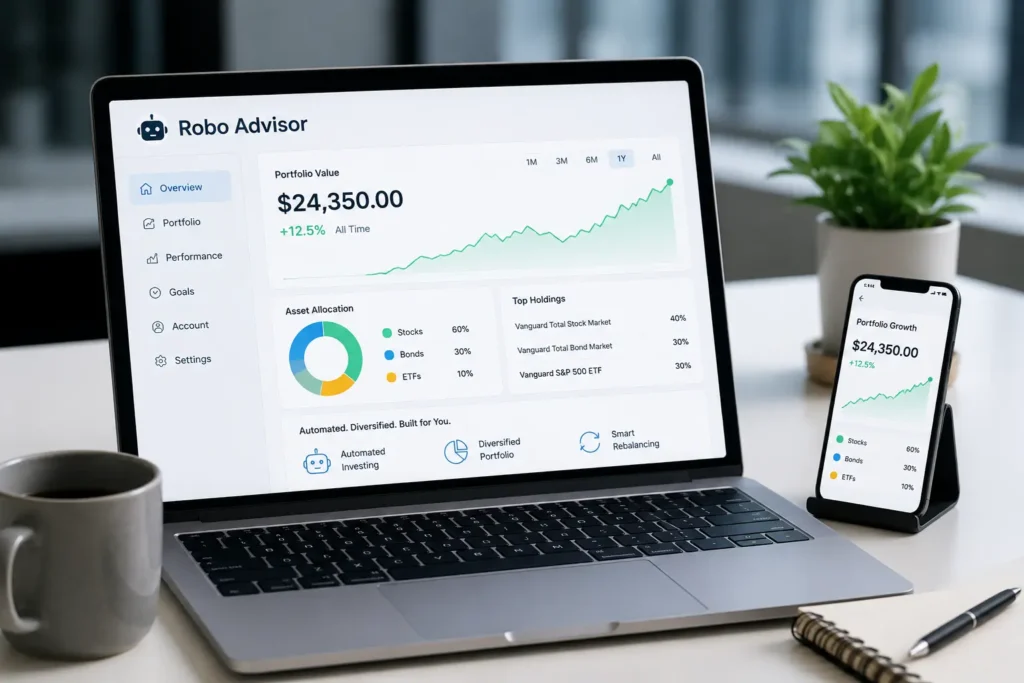
THE THING NOBODY ACTUALLY SAYS OUT LOUD
Here’s the thing: most people don’t want to “learn investing.” They want to not feel stupid when they open their bank app. That’s the real product.
Robo-advisors sell this feeling packaged as “personalized, AI-powered investing tailored to your goals,” which sounds impressive until you realize step one is a quiz that asks, “How would you feel if your portfolio dropped 20%?” As if anyone clicks “I’d be chill about it.”
Under the hood, most robo-advisors are doing something pretty old-school: building a mix of low-cost index funds (ETFs) based on your risk tolerance, rebalancing when allocations drift, and sometimes optimizing taxes. They’re less “sentient Wall Street genius” and more “polite spreadsheet that keeps you from detonating your future.”
Here’s what never makes it into the glossy landing page copy:
- The core algorithms are usually built on modern portfolio theory and risk models that have existed longer than you have. The AI layer is often focused on improving recommendations, personalization, or trade execution not wizard-level market timing.
- When websites say “over $1 trillion managed by robo-advisors globally,” it doesn’t mean the AI is amazing. It often means the fees are lower, onboarding is easier, and humans are tired. Lower friction wins.
- Many top robo-advisors are owned by big, boring financial institutions: Vanguard, Schwab, Fidelity, etc. Translation: the tech is decent, but the real flex is brand trust and compliance departments the size of small cities.
The dirty secret is that robo-advisors aren’t here to beat the market; they’re here to stop you from doing something dumb while still letting the platform skim a predictable fee.
If you’re a CS or AI student, you already know how this game works. The “AI magic” is usually just a mix of: risk-scoring based on behavioral data, clustering similar users, tweaking allocations using backtested models, and automated monitoring. None of that is bad it’s just not the sci-fi story the ads are selling.
Think of a robo-advisor like autopilot in a plane. It won’t make you a better pilot. It just stops you from nose-diving while you’re distracted scrolling memes. Same with investing: the point is not alpha. The point is not blowing up your future because you saw a TikTok about options trading .
HOW THIS ACTUALLY WORKS THE REAL MECHANICS
Strip away the marketing, and most AI-powered robo-advisors follow a similar workflow.
- You onboard and answer a questionnaire
You tell the platform your age, income, goals (“retire”, “buy a house”, “idk, just grow it”), and your tolerance for volatility. It feels like a BuzzFeed quiz, but those inputs feed their risk models. - The algorithm builds a target portfolio
Based on your profile, it creates a portfolio of ETFs across stocks, bonds, maybe real estate or alternatives, and assigns target percentages. For example: 90% global stocks, 10% bonds if you’re young and aggressive; more bonds and cash if you’re closer to needing the money. - It monitors and rebalances automatically
As markets move, your allocations drift. If stocks rally hard, suddenly your “90/10” becomes “95/5,” meaning more risk than you signed up for. Robo-advisors automatically sell what’s overweight and buy what’s underweight to pull you back to your target. - Some add tax features and smart routing
U.S.-focused platforms like Betterment and Wealthfront can do tax-loss harvesting: selling losing positions to offset gains and reduce your tax bill, then buying similar assets so your allocation stays intact. This is where AI and automation actually add dollar value at scale. - The AI layer: personalization at scale
Newer platforms use AI to analyze user behavior, market conditions, and portfolio performance to refine recommendations or nudge you: increase contributions, adjust risk, or rebalance strategically. In practice this means gentle push notifications that feel like a financial parent tapping your shoulder.papers.
Where things get interesting and where generic articles rarely go is how different platforms emphasize different “AI” angles:
- Some focus on behavioral nudging predicting when you might panic sell and buffering that with calming in-app education.
- Some focus on tax and fee optimization , trying to squeeze more after-tax return from the same boring index funds.
- Some tie into brokers or banks you already use , turning “set up account” into “tick this box and you’re invested.” Frictionless onboarding is a bigger moat than any model.
Here’s a short, opinionated list of what you’ll actually notice using these:
- Betterment: Clean UX, good for US-based beginners who want “just handle it” portfolios, solid goal tracking.
- Wealthfront: Feels more “techy,” strong automation, good for people who might later want to tweak or add custom features.
- Vanguard Digital Advisor: Boring in the best way; ideal if you want long-term index investing with minimal drama.
- Schwab Intelligent Portfolios: No advisory fee, but higher minimums and cash drag (they keep a big chunk in cash), which is the “catch.”
- SoFi Automated Investing / Acorns: App-first, super easy to start with small amounts, but less depth for advanced users.
If you’re in that AI/tech student zone, the mechanics are not hard to grasp. The hard part is admitting you might be better off letting a fairly boring algorithm manage your money than trying to outsmart the market between exams.
COMPARISON WHAT’S ACTUALLY DIFFERENT BETWEEN YOUR OPTIONS
Here are some of the main AI-powered robo-advisors people in the US look at in 2026.
| Option | What it actually does | Who it’s for | The catch |
| Betterment | Builds ETF portfolios, auto-rebalances, offers tax-loss harvesting and goal tracking. | Beginners to intermediate users who want to “set and forget” with smart features. | Charges advisory fee; Fewer knobs to tweak if you want full control. |
| Wealthfront | Automated diversified portfolios with strong tax tools and optional customization. | Techy users who may later want more features and flexibility. | Higher minimum than some apps; US-focused taxable/tax-advantaged setup. |
| Vanguard Digital Advisor | Low-cost index-based portfolios focused on long-term wealth building. | People who vibe with “boring is good” and trust Vanguard branding. | Interface feels more old-school; fewer flashy features. |
| Schwab Intelligent Portfolios | Automated portfolios via Schwab with no advisory fee and broad ETF mix. | Users who want a big-name broker plus automation in one place. | Keeps large cash allocation, which can drag returns over time. |
| SoFi Automated / Acorns | Round-up or small recurring investments into ETF portfolios in app-first experiences. | Students and new investors starting with tiny amounts. | Limited depth; fees can be high relative to very small balances. |
If you want one clear take: start with something like Betterment or Wealthfront if you’re US-based and serious about long-term investing, then graduate to more control later. If you’re just trying to not leave your money dying in a checking account, Acorns or SoFi are training wheels, not your final setup.
WHAT ACTUALLY HAPPENS WHEN YOU TRY THIS
When you actually go through the process, it feels almost too easy. That’s the weird part.
You download the app or open the site. It asks for your age, income, goals, time horizon, and gives you a few sliders for “How do you feel about risk?” You answer in this awkward mix of bravado and anxiety because you want high returns and you don’t want to see a red -30% screen.
Then you get a projected graph. A neat little curve showing “if you invest X per month, here’s what you might have in 30 years.” It’s all very calm, very “you’re doing the adult thing.” You pick a plan, connect your bank, set up automatic contributions, and in under 20 minutes you’ve gone from “I should invest someday” to actually owning a slice of global markets.
The first surprise: nothing dramatic happens. There’s no cinematic “trade executed” moment. Your portfolio just… exists. It quietly buys ETFs on schedule. The AI doesn’t DM you with genius predictions. Mostly, it stays out of your way.
Over the next few weeks, you’ll notice a few patterns that generic articles usually skip:
- You stop obsessively stock-picking because now you have a boring, diversified baseline running in the background. That becomes your “default adult money.”
- You care less about daily price swings and more about contribution amounts. Once you see the projections update when you change “$100/month” to “$300/month,” you realize the boring truth: deposits matter more than drama.
- When markets drop, the app rebalances automatically buying more of what’s fallen to keep allocations steady. That’s the exact opposite of what most humans do when left alone.
One thing that might catch you off guard: how much the UI shapes your behavior. A calm portfolio summary page with simple charts will keep you invested. A flashy “market news” feed jammed with volatility headlines will tempt you into tinkering.
Most people find that after the first setup, they log in less and less which is actually good for long-term returns. The whole point of automation is to remove your feelings from 95% of the process.
But here’s the pattern almost no article calls out: the real “AI benefit” isn’t in picking miracle assets. It’s quietly enforcing basic investing hygiene diversification, rebalancing, tax efficiency, staying invested through ugly days. The stuff everyone says they’ll do manually and almost nobody actually does.
If you’re coming from a world of order books, TradingView, and YouTube “strategies,” robo-advisors will feel boring. That boredom is the feature.
THE ADVICE EVERYONE GIVES VS WHAT ACTUALLY WORKS
Let’s clean up some bad or incomplete advice you’ve probably seen around AI robo-advisors.
“Just pick the one with the lowest fee”
Yes, fees matter. Paying 0.25% vs 1% over 30 years is a huge difference. But obsessing over a tiny fee difference while ignoring tax features, cash drag, or product fit is how you save $10 to lose $1,000.
What actually works:
- Check the all-in cost : advisory fee plus ETF expense ratios plus hidden stuff like large cash allocations earning low interest.statistician+2
- Compare what you get for that fee: Does it include tax-loss harvesting? Good goal planning? Solid UX that you’ll actually stick with?
If you’re investing a few hundred bucks, the difference between 0.25% and 0.35% is noise. Pick the platform you’ll actually use consistently.
“AI will beat human advisors anyway”
This one’s half fanboy, half cope. Robo-advisors are not built to “own the market.” They’re built to provide low-cost, rules-based investing with minimal human interaction.papers.
What actually works:
- Think of robo-advisors not as “beating humans,” but as replacing a certain type of human the generic, high-fee advisor who would have put you in similar index funds anyway.
- The edge is discipline at scale , not secret sauce. AI is good at sticking to rules, monitoring 24/7, and optimizing repetitive decisions.
If you want to chase alpha, that’s a separate conversation. Your robo-advisor is your boring core your experiment money happens elsewhere.
“You don’t need to learn anything, the AI handles it”
Tempting. Also dangerous. Blind trust is not a strategy.
What actually works:
- Learn just enough to be dangerous in a useful way: what risk means, what an ETF is, what “diversification” really does and does not protect you from.
- Understand your own settings: if you set “aggressive” and freak out when your portfolio drops 25% in a crash, that’s not the AI’s fault. That’s you mislabeling your own psychology.
You don’t need a finance degree. You do need to understand the rules of the game you’ve signed up for.
“Start with $1, it’s all about time in the market”
Cute slogan. And yes, starting early matters. But if you stay at $5 or $10 a month forever, you’re mostly training the app, not building serious wealth.
What actually works:
- Use the first few months to test the platform and your comfort level. Then ramp contributions when you’re confident.
- Treat contributions like a subscription you pay your future self. If you can pay $15/month for streaming, you can probably push your investing contribution up too.
Time in the market matters. So does actually putting meaningful money in.
THE PRACTICAL PART WHAT TO ACTUALLY DO
Here’s the part you can screenshot and follow.
1. Pick your “boring core” platform
Decide if you’re US-based and eligible for Betterment, Wealthfront, Vanguard Digital Advisor, or Schwab Intelligent Portfolios these cover most serious beginner use cases. If you’re super early and only able to invest tiny amounts, SoFi or Acorns are acceptable training grounds, but plan to upgrade later.
Choose one. Don’t bounce between five apps. Fragmented portfolios are just chaos in a trench coat.
2. Set one clear goal and time horizon
When the app asks what you’re investing for, don’t click everything. Pick one core goal: long-term wealth, house down payment in 10 years, etc. The time horizon will heavily shape your risk level.
If you’re 20–30 and investing for retirement, that’s easily 30–40 years. You can afford more volatility. If it’s money you might need in three years, set the risk lower. Future you will be grateful you didn’t gamble your down payment.
3. Be honest on the risk questionnaire
When it shows those “what if you lost X%?” questions, imagine real money. Like actual rent money. Not simulation tokens.
Answer based on how you panic during market drops if you’ve never lived through a real one, err slightly conservative at first. You can always bump risk up later when you’ve seen red days and survived.
4. Automate contributions like a bill
Set up automatic weekly or monthly transfers from your bank into the robo-advisor. Even $50 or $100 at first is fine. The point is turning this into muscle memory, not heroic one-time deposits.
Once it runs for a couple of months and you realize you don’t miss the money, increase the amount. You want your future self to look back and say “Wow, that was annoying, but it worked.”
5. Commit to a “no touching without a reason” rule
Give yourself rules. For example:
- Only log in once a week or once a month.
- Don’t change risk level or portfolio settings unless something real changes: income, goals, or time horizon.
Your job is to protect the system from you . The automation is already doing its part rebalancing, reinvesting, monitoring.ig+1
6. Use the dashboard like a debugging tool
Every month or quarter, look at:
- Current allocation vs target allocation.
- Contribution total vs growth from the market.
- Projected outcomes if you increase contributions.
Treat it like debugging a model: adjust inputs (contribution amount, time horizon), not the underlying engine, unless something is clearly broken.
7. Keep your “fun risk” separate
If you still want to stock-pick, trade crypto, or try algo-strats, that’s fine just don’t do it inside your robo-advisor account.
Have a separate “high-risk sandbox” account with a fixed percentage of your overall money. The robo-advisor is your boring backbone. The sandbox is your playground. Don’t mix the two.
QUESTIONS PEOPLE ACTUALLY ASK
How do AI robo-advisors actually work?
They collect your data age, goals, time horizon, risk comfort through an onboarding questionnaire, then map you to a risk profile. Based on that, they construct a portfolio of diversified ETFs with target percentages for each asset class. The system then monitors your portfolio and automatically rebalances when allocations drift too far from target. Some platforms add AI-based personalization, tax optimization, and behavioral nudges to keep you invested and aligned with your goals.papers.
Are robo-advisors safe for beginners?
From a process perspective, yes many leading robo-advisors are owned by large, regulated financial institutions. Your money is usually held in custodial accounts with protections similar to traditional brokerages, and the actual investment strategy is intentionally simple and diversified. The real risk is not the platform blowing up; it’s you choosing an overly aggressive risk level and panicking during market drops. That’s why understanding your own tolerance matters more than picking the “coolest” app.
Can AI robo-advisors beat the stock market?
Most are not trying to. Their portfolios often track broad market indexes, sometimes with small tilts. Over long periods, they aim to deliver market-like returns minus modest fees, not crush benchmarks like a hedge fund. Where they might add value is through lower behavioral mistakes, better diversification, and tax features like tax-loss harvesting that improve after-tax returns. If you want aggressive outperformance, that’s a different, and riskier, game.
How much money do I need to start with a robo-advisor?
Minimums vary. Some platforms like Betterment or SoFi let you start with very low amounts or no strict minimum for basic accounts. Others, like Wealthfront or certain Vanguard and Schwab offerings, have minimums in the hundreds or low thousands of dollars. Practically, you’ll feel more impact when you’re able to deposit at least $50–$100 per month but starting small to learn the system is completely valid.
Are robo-advisors really using AI or is that just marketing?
There’s a bit of both. The core investing engine is usually based on established portfolio theories and rule-based algorithms. The “AI” parts commonly show up in personalization, pattern detection, risk scoring, and automating complex tasks like tax-loss harvesting. Some platforms are more honest about this than others, so treat “AI-powered” as a signal of automation and data use, not literal financial superintelligence.
What happens if the market crashes while I’m using a robo-advisor?
Your portfolio will likely drop in value along with the broader market there’s no magic shield. However, the system will usually rebalance by buying more of the assets that have fallen to keep your allocation aligned with your risk profile. If you’ve chosen an appropriate time horizon and risk level, the strategy is to stay invested and keep contributing, not to bail. The automation helps by sticking to rules even when your emotions disagree.
Are robo-advisors better than managing my own index funds?
If you’re disciplined, understand asset allocation, and are willing to rebalance and tax-optimize yourself, DIY index investing can be cheaper. Most people, especially students juggling a million other things, don’t consistently do that. Robo-advisors are better for people who value automation, behavior protection, and not having to think about rebalancing, tax lots, or drift. It’s less about “better” and more about “more realistic for your actual habits.”
Can I use a robo-advisor and still pick individual stocks?
Yes, and many people do. The typical pattern is to use a robo-advisor as your core, long-term portfolio and run a separate brokerage account for individual stock picks or higher-risk experiments. That way, your long-term strategy stays stable while you scratch the curiosity itch elsewhere. The key is defining in advance what percentage of your money is allowed in the “fun risk” bucket so you don’t slowly cannibalize your core investments.
SO WHERE DOES THIS LEAVE YOU?
You’re in a world where your phone can run a language model, your fridge wants Wi‑Fi, and an algorithm can build you a globally diversified portfolio in under 15 minutes. The hard part is not accessible. It’s focus.
AI-powered robo-advisors are good at one thing that actually matters: enforcing boring, consistent behavior. They take the classic, unsexy investing rules and wrap them in a UI you might actually use. They also charge for the privilege not extortion-level fees, but not zero either.
So here’s the concrete move: pick one viable robo-advisor, set up a single long-term goal, start with an amount you can actually stick to each month, and commit to letting it run for at least a full market cycle. No heroic timing. No panic switches because someone on social media yelled “recession.”
It won’t make you rich overnight. It won’t make investing glamorous. But it will give Future You something better than regret and screenshots of old “I almost bought that stock” moments. And honestly, that’s already a win.