
If you hang out in AI circles long enough, someone will eventually say “once quantum hits, all these GPUs are basically toasters.” Then they go back to complaining about CUDA versions.
On the other side, quantum folks talk about “quantum advantage” like it’s tomorrow, while their devices still throw tantrums after a few hundred noisy operations. It feels like two different movies playing at once: one about billion‑parameter models and one about a handful of very unstable qubits.
By 2026, the realistic picture is more boring and more useful. Quantum computing is not replacing GPUs for training LLMs any time soon. But hybrid quantum-classical setups are starting to show small but real gains on specific machine-learning tasks, especially where classical methods struggle complex pattern recognition, optimization, and simulation-heavy problems. A survey of NISQ-era (noisy intermediate-scale quantum) work and recent hybrid experiments show 3–8% accuracy gains on tough datasets when small quantum circuits are spliced into classical networks.
This article is about that gap between hype and reality: how quantum is likely to shape AI development over the next decade, what’s actually being tried in 2026, and what you should bother learning if you’re an AI/tech student who doesn’t want to get blindsided by future buzzwords.
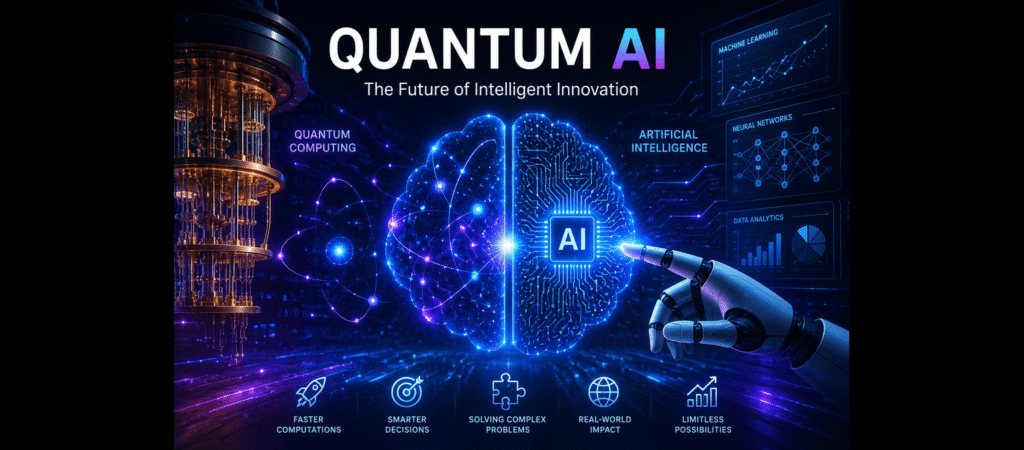
THE THING NOBODY ACTUALLY SAYS OUT LOUD
Most articles about “quantum + AI” sound like a press release and a sci‑fi trailer had a child. They promise “exponential speedups” and “solving problems in seconds that would take the universe’s lifetime,” then quietly skip the part where current devices fall over midway through a non‑trivial circuit.
Reality check that rarely makes the keynote slide:
In 2026, the smartest people in the room are not trying to build ‘quantum AI’ from scratch. They’re sneaking tiny quantum circuits into existing AI systems exactly where classical methods choke.
A 2025–2026 analysis of hybrid quantum-classical ML puts it bluntly: instead of rebuilding full neural nets, companies embed compact quantum blocks into classical models like DLC. The pattern looks like this:
- classical layers extract features (conv layers for images, sequence layers for time‑series)
- a small quantum circuit processes a compressed representation where classical linear layers would struggle
- the result is fed back to classical layers for the final decisionojs.
In those experiments, you don’t see “1000× speedup,” you see “3–8% higher accuracy on ugly, high-dimensional data,” like subtle medical images where classical models plateaued. That’s not sexy on Twitter, but in a regulated domain it might be the difference between “publishable” and “nope.”
On the hardware side, companies like D-Wave and Quantinuum are publishing roadmaps that quietly admit we’re in a long game. D‑Wave’s 2026 roadmap targets 100 logical qubits capable of over 1 million operations by 2032 with milestones of error‑corrected 17‑, 49‑, and 181‑physical‑qubit systems along the way. IBM’s own messaging points to hoping for quantum advantage around 2026 and large-scale fault-tolerant systems closer to 2029.
And yet, you’ll still see LinkedIn posts that talk like we’re two firmware updates away from training GPT‑7 entirely on a photonic quantum chip. Sure.
The uncomfortable, less viral truth:
- Near-term quantum devices (NISQ) are noisy, small, and best used in hybrid schemes, not as stand-alone AI engines.
- Quantum advantage for broad AI workloads is a 2030‑plus story, tied to error‑corrected logical qubits and serious gate counts.
- The real action in 2026 is in “quantum utility” cases where quantum hardware, plugged into classical AI and HPC, starts solving some optimization, simulation, or search problems better than classical alone.
If you’re an AI student, that’s the mental model to keep: you’re not waiting for some magic switch from “AI” to “quantum AI.” You’re heading towards a world where GPUs, TPUs, CPUs, and QPUs sit on the same diagram, and parts of your pipeline quietly jump between them.
HOW THIS ACTUALLY WORKS THE REAL MECHANICS
Let’s break the “quantum will change AI” claim into parts that correspond to actual hardware and code, not vibes.
1. NISQ devices and why they’re annoying
We’re still in the NISQ era: devices with tens to low-hundreds of physical qubits, limited coherence times, and non-trivial error rates.
- You can run circuits of modest depth before noise overwhelms the signal.
- You can’t yet keep large circuits alive long enough for complex algorithms like full-scale Shor or big quantum neural networks.
A 2025 survey of NISQ-era advances emphasizes hybrid quantum-classical computing as the sane path: use quantum subroutines where they help, and keep everything else classical. QEC (quantum error correction) is being demoed in pieces, but full fault tolerance replacing every physical qubit with encoded logical qubits plus continuous error‑correction is still in “roadmap slide” territory.
Q‑CTRL’s 2026 roadmap framing is useful:
- NISQ regime: QEC not widely available, devices small and noisy, hybrid tricks dominate.
- QEC advantage: QEC exists and gives net benefit; logical qubits usable for some algorithms.
- Fault-tolerant regime: large, efficient logical systems run long algorithms commercially.
We’re somewhere between late NISQ and early QEC demos, not “fully fault‑tolerant AI supercomputer.”
2. Hybrid quantum–classical ML (where the interesting stuff is)
Hybrid quantum–classical ML, in practice, looks less exotic than you’d expect.
A 2025 article on “hybrid quantum‑classical ML finally leaving the chat” describes it as: “sneaking quantum circuits into neural networks where classical layers start crying for help.”
Common patterns:
- Quantum feature embeddings: encode classical data into quantum states to exploit high‑dimensional Hilbert spaces.
- Variational quantum circuits (VQCs): small parameterized circuits trained like neural layers via classical optimizers.
- Quantum convolution or kernel modules: used inside CNNs or SVM‑like models to capture complex correlations.
The NearLearn article cites cases like quantum CCNNs (hybrid convolutional networks) boosting accuracy on breast cancer diagnosis datasets by 3–8% compared to purely classical baselines. Academic work on hybrid quantum-classical CNNs emphasizes resource-efficient designs that fit NISQ constraints by keeping quantum blocks tiny and shallow.
Quantum architecture search is another niche: papers on hybrid quantum-classical neural architecture search propose using quantum circuits to explore architecture spaces more efficiently than classical search alone.
Conceptually, it’s like adding a weird, expensive layer to your network that you only call when you really need it.
3. Quantum hardware roadmaps aimed at AI and HPC
Vendors are finally saying the quiet part out loud: quantum computers will live next to classical HPC and AI stacks, not replace them.
Quandela’s 2026 trends list hybrid quantum–classical computing and early industrial pilots as key signs of maturing systems: photonic processors working alongside classical infrastructure to accelerate complex optimization and AI workloads. A 2026 AI‑trends video from IBM technologists talks about “quantum utility everywhere” quantum resources connected into cloud AI infrastructure as just another specialized compute option.
On the hard roadmap side:
- D‑Wave’s 2026 plan aims for a 17‑physical‑qubit error‑corrected system in 2026, scaling to 181 physical qubits by 2028 and 10 logical qubits by 2030, then 100 logical qubits by 2032 with over 1 million operations enough for early quantum chemistry and quantum AI use cases.
- IBM’s updated path expects quantum advantage by ~late‑2026 and large‑scale fault‑tolerant machines by around 2029, based on recent error‑correction progress.
- Quantinuum and HPE announced a 2026 collaboration explicitly to build hybrid quantum–HPC–AI architectures, integrating QPUs into existing HPC/AI infrastructure and benchmarking joint workflows.
This is all very “roadmap,” but it tells you how serious players are framing it: quantum is a specialized accelerator for certain subproblems, not the whole stack.
4. Quantum AI market and near-term use cases
Market‑wise, quantum AI is tiny but real. Precedence Research estimates the quantum AI market reaching around 638 million USD in 2026, up from ~474 million in 2025. That’s small compared to cloud AI spend, but it signals a shift from pure research to early pilots.
Near‑term AI‑adjacent areas where quantum is being explored:
- optimization: routing, scheduling, portfolio optimization, supply-chain logistics
- simulation: quantum chemistry and materials for better batteries, drugs, etc.
- kernel methods and quantum‑enhanced pattern recognition
- cryptography and security (both offensive and defensive)
The common thread: if your AI depends on solving hard optimization or sampling problems, or on simulating quantum systems, quantum hardware has a shot at helping earlier than in generic LLM training.
COMPARISON WHAT’S ACTUALLY DIFFERENT BETWEEN YOUR OPTIONS
From an AI developer’s perspective, you’re not choosing “quantum yes/no,” you’re choosing how it shows up.
| Option / Stage | What it actually does | Who it’s for | The catch |
| Pure classical AI (CPUs/GPUs/TPUs only) | Standard ML/LLM stack; handles almost all current workloads. | 99% of AI practitioners today. | Hits scaling walls on some optimization, simulation, and search problems. |
| NISQ‑era hybrid quantum–classical ML | Small quantum circuits embedded in classical models for niche gains on hard tasks | Researchers, labs, and companies doing early‑stage quantum AI pilots. | Noisy hardware, limited qubits, complex toolchains, modest improvements. |
| Future fault‑tolerant quantum + AI | Large logical-qubit systems accelerate certain AI training/inference subroutines | 2030s‑era advanced AI/HPC shops, not normal devs yet. | Depends on full QEC, serious hardware scale, and new algorithms. |
My take:
- As a student or engineer, you should treat hybrid quantum–classical as the relevant concept for the next 5–10 years, not “full quantum AI.”
- Keep your classical AI skills primary ; quantum is a specialization that plugs into specific parts of the pipeline, especially optimization and simulation.
- Pay attention to hardware roadmaps mainly to understand when “quantum utility” in cloud environments might start touching workloads you care about.
WHAT ACTUALLY HAPPENS WHEN YOU TRY THIS
When you actually sit down to build something “quantum‑AI flavored” in 2026, it feels less like stepping into a new universe and more like adding a cursed extra accelerator to an already messy stack.
Suppose you’re working on a medical-imaging classifier and you’ve plateaued on a tough dataset. You read the NearLearn article about hybrid quantum–classical ML and decide to try a small variational quantum circuit (VQC) inside your network.
The process looks like this in practice:
- You take your existing CNN and insert a layer where high-level features get projected down to a low-dimensional vector.
- You encode that vector into a quantum state using some parameterized mapping (angles on qubits).
- You run a shallow VQC on a NISQ device (or simulator) to transform the state, then measure and feed the outputs back into the classical network as features.
Most of the time, your bottleneck isn’t the “quantum magic,” it’s:
- getting your dev environment working with a vendor’s SDK,
- keeping circuit depth low enough that real hardware doesn’t drown in noise,
- dealing with queue times and cost if you’re using cloud QPUs.
When hybrid papers report 3–8% accuracy gains (like in the cited breast-cancer classification example), they’re usually after a lot of tuning and comparing to strong classical baselines. The surprise is not that quantum wins; it’s that it can eke out consistent improvements on some tricky, limited‑data problems despite its hardware handicaps.
On the systems side, if you’re anywhere near HPC, you start seeing “quantum + AI” show up in architecture diagrams. Quantinuum’s 2026 collaboration with HPE is a good example: they’re literally trying to glue quantum systems into HPC and AI infrastructure as “a practical extension” of existing stacks, not a replacement. The day‑to‑day impact on devs is subtle: new SDK calls, new offload options, new profiling headaches.
One pattern that doesn’t show up in hype posts: hybrid workflows only stick if they’re boring to use. Quandela’s trend report talks about hybrid quantum–classical computing as a sign of “concretization” first industrial use cases where quantum accelerators are just another part of a pipeline, not a special project off to the side. Teams that hide quantum behind normal APIs get somewhere. Teams that require every ML engineer to become a quantum physicist… don’t.
What surprised me most reading through 2026 material is how the tone shifted. Early papers sounded almost apologetic about NISQ limitations. Newer ones are more like: “we know the hardware is trash, here’s a design that gets value anyway.” That mindset pragmatic abuse of imperfect tools is exactly how AI folks already treat GPUs, so the cultures are starting to rhyme.
THE ADVICE EVERYONE GIVES VS WHAT ACTUALLY WORKS
“Quantum will make all current AI obsolete”
This is the Netflix-killed-Blockbuster version of the story. It’s clean, dramatic, and almost certainly wrong in the details.
Why it fails:
- Current AI stacks are deeply optimized for classical hardware; ripping them out is not happening overnight.
- Vendors like D-Wave and IBM explicitly talk about hybrid quantum-classical and “quantum utility” alongside existing HPC and AI, not replacing them wholesale.
What actually works: think of quantum as a future specialized accelerator for particular subproblems optimization, sampling, simulation that sit inside larger AI systems. You’ll tweak parts of the stack, not throw it away.
“You should start by learning full quantum algorithms and physics”
If you love physics, sure. If you’re primarily an AI dev, this is like telling a backend engineer they must start with RF engineering to work with Wi‑Fi.
Why this is incomplete:
- Most near-term “quantum + AI” work uses high-level SDKs and hybrid frameworks.
- Surveys emphasize application‑level hybrid designs and resource constraints more than raw algorithm theory.
What actually works: learn enough to understand qubits, gates, noise, and why NISQ is annoying. Then focus on hybrid patterns: how to slot small quantum circuits into ML pipelines, and how to reason about when it’s worth it.
“Quantum advantage for AI will arrive any minute now”
Roadmaps and LinkedIn posts love this line. The actual numbers are more conservative.
Why it’s overhyped:
- D‑Wave’s roadmap to 100 logical qubits with 1M operations sits around 2032, not 2026.
- Q‑CTRL’s breakdown shows we’re only just entering a “QEC advantage” era, with full fault‑tolerant regimes further out.
- IBM’s internal expectations aim for advantage around 2026 and fault‑tolerant systems by ~2029, which is still years away from “routine AI workloads.”
What actually works: treat 2026–2030 as the hybrid experimentation period. Real, general quantum advantage for broad AI training/inference is more of a 2030s story.
“Quantum AI is only relevant for big enterprises and PhDs”
To be fair, most actual deployments right now are in research labs and big-budget pilot programs. But that’s how cloud AI started too.
Why is this too narrow:
- The quantum AI market is small but growing, projected around 638 million USD in 2026, up about 35% from 2025.
- Cloud vendors are explicitly trying to hide quantum complexity behind managed services and hybrid integrations with existing AI infrastructure.
What actually works: as a student or early‑career dev, you don’t need production access to a QPU to be relevant. You need:
- a solid classical AI foundation
- a conceptual grasp of how hybrid quantum–classical ML works
- enough literacy to read roadmap slides and call BS when needed
THE PRACTICAL PART WHAT TO ACTUALLY DO
You can’t buy a fault-tolerant quantum AI box. You can future‑proof yourself a bit without wrecking your brain.
1. Get your classical AI fundamentals solid
Quantum is not a shortcut to skip understanding optimization, generalization, or architectures.
- Focus on deep-learning basics, optimization methods, and probabilistic thinking.
- Hybrid quantum methods still rely on classical training loops and evaluation.
If your classical ML is shaky, quantum won’t save you; it’ll just give you new ways to be confused.
2. Learn “quantum 101” targeted at developers
You do not need a full QFT course to be useful. You do need to know:
- what qubits, superposition, and entanglement roughly mean
- why noise and decoherence are such a pain
- the difference between NISQ, QEC, and fault-tolerant regimesojs.
Pick one dev-focused intro that uses a major SDK (Qiskit, Cirq, etc.) and get to the point where you can run toy circuits and understand what’s happening conceptually.
3. Play with at least one hybrid quantum–classical ML example
Use a cloud simulator or a free tier on a quantum service to:
- Build a tiny hybrid model (eg, classical CNN + quantum layer) following a tutorial inspired by hybrid CCNN papers.
- track metrics: accuracy change, training stability, latency.
The goal isn’t to beat SOTA; it’s to feel how messy and constrained NISQ hardware is and where quantum blocks might make sense.
4. Follow hardware and roadmap news like a skeptical engineer
Skim:
- vendor roadmaps from IBM, D‑Wave, Quantinuum, and othersquantinuum+2
- neutral analyzes (IDTechEx, market reports) about likely timeframes for quantum advantage and commercial use cases.
Flag three questions every time you see hype:
- what qubit count and error rates are we talking about?
- is this NISQ or error-corrected logical qubits?
- is the use case optimization/simulation or generic “AI”?
5. Think about where AI you care about hits hard problems
Ask: where in your favorite AI domains do we struggle with:
- combinatorial explosion (routing, scheduling, multi‑agent coordination)
- sampling from nasty distributions
- simulating physics or chemistry
Those are the subproblems most likely to see quantum help first. Even if you never touch a QPU, understanding these pain points is good AI engineering hygiene.
6. Learn to read “quantum AI” claims critically
Next time you see a post claiming “quantum beats classical on AI task X”:
- check if the classical baseline is strong
- see if the quantum model is hybrid and how many qubits/operations it uses
- look for details on whether results came from a simulator or real hardwarepmc.
This alone will keep you from getting swept into hype cycles and make you sound annoyingly grounded in conversations, which is a feature.
QUESTIONS PEOPLE ACTUALLY ASK
Will quantum computers make current AI models obsolete?
Not in the near term. Current LLMs, diffusion models, and standard ML pipelines are built around classical hardware and will keep improving on GPUs/TPUs. Quantum is more likely to show up as a specialized accelerator for certain subproblems optimization, sampling, simulation inside those pipelines. Over the long term, some training or inference routines may shift to hybrid or quantum‑enhanced versions, but that’s an evolution, not a sudden replacement.
What is hybrid quantum–classical machine learning?
It’s a setup where quantum circuits are embedded into classical ML models rather than replacing them. Classical layers handle most feature extraction and learning, while small quantum blocks process compressed representations or solve subproblems where quantum effects may help. Studies in the NISQ era report modest but real gains often a few percentage points in accuracy on specific complex tasks like medical image classification.
When will quantum computing actually help train AI models?
For broad, mainstream AI training, probably not before the 2030s. Roadmaps from companies like D-Wave and IBM suggest fault-tolerant systems with enough logical qubits for serious algorithms around 2029–2032. In the meantime, hybrid NISQ‑era methods can already help on narrow tasks such as optimization or specialized pattern recognition, but they don’t replace standard GPU‑based training.
What’s the difference between NISQ and fault-tolerant quantum computing?
NISQ (noisy intermediate-scale quantum) refers to current devices with tens to low-hundreds of physical qubits and significant noise, which limits circuit depth and reliability. Fault-tolerant quantum computing uses error-corrected logical qubits built from many physical qubits, allowing long, complex computations with low effective error rates. Most near-term “quantum AI” work happens in the NISQ regime with hybrid designs, while large-scale AI acceleration will require fault-tolerant systems.
Are there real-world examples of quantum helping AI yet?
Yes, but they’re early and niche. Hybrid quantum-classical CNNs and kernel methods have shown 3-8% accuracy improvements on challenging datasets like breast cancer imaging compared to classical baselines. Industrial pilots focus on combining quantum optimization or simulation with classical AI in areas like logistics, finance, and materials discovery. These are pilot projects, not mainstream production workloads yet.
How big is the quantum AI market right now?
It’s small but growing. Precedence Research estimates the quantum AI market rising from about 473 million USD in 2025 to roughly 638 million USD in 2026. That’s tiny next to overall AI spend, but it signals that companies are moving from pure research to paid pilots and early deployments, especially in industries that already depend on heavy computation.
Should I, as an AI/tech student, learn quantum computing?
It depends on your goals. If you want to work directly on quantum algorithms or hybrid ML, you’ll need quantum basics and some exposure to SDKs like Qiskit or Cirq. If your focus is general AI engineering, it’s more important to: understand classical AI deeply, know what quantum can and can’t do in the NISQ era, and be literate enough to collaborate with specialists when relevant. Quantum fluency is a bonus, not a prerequisite, for most AI roles in the 2020s.
How will quantum computing change AI infrastructure?
The likely path is “amorphous hybrid computing,” where CPUs, GPUs, TPUs, neuromorphic chips, and quantum processing units (QPUs) all coexist in cloud environments. Workloads will be partially and automatically mapped to whichever substrate is best for that part of the computation. From a developer’s perspective, this looks like more offload options and APIs, not a complete rewrite but it does mean thinking more carefully about where different parts of your pipeline run.
SO WHERE DOES THIS LEAVE YOU?
Quantum computing and AI are on a collision course, but it’s more like a slow orbital merger than a Marvel crossover event. In 2026, the reality is: NISQ‑era devices exist, hybrid quantum–classical ML is showing small wins on hard problems, and hardware roadmaps point towards more serious quantum utility in the 2030s.
For you as an AI‑curious student, the important part isn’t memorizing gate sets. It’s understanding the division of labor: GPUs and TPUs will keep doing the heavy lifting for most models, while quantum hardware slowly carves out a niche in optimization, simulation, and certain high‑complexity learning tasks. If you can reason about where your models struggle and which subproblems are fundamentally hard, you’ll know when “quantum help” is a real option and when it’s just slideware.
If you want one concrete step today: pick a good hybrid quantum–classical ML tutorial and implement a tiny model that uses a quantum layer alongside a classical network even on a simulator. Don’t do it because it’ll beat your GPU; do it so that the next time somebody hand‑waves about “quantum AI,” you have actual experience instead of just buzzwords.
You made it all the way through a long article about quantum and AI without rage‑quitting back to short‑form videos, which is already more disciplined than most timelines deserve.
Quantum computing is not going to wake up one day and make all current AI look stupid. It’s going to quietly slip into the background of certain workloads, the way GPUs did for graphics, until one day we all act like it was inevitable. If you can stay fluent in the boring bits constraints, roadmaps, hybrid patterns you’ll be useful on both sides of that transition, which is more than you can say for half the hype posts in your feed.